
Have you ever gone to a great workshop or retreat, come home lit up, and been sure that this time everything would be different? And then by Wednesday, it was like it never happened?
That’s not failure. That’s weather.
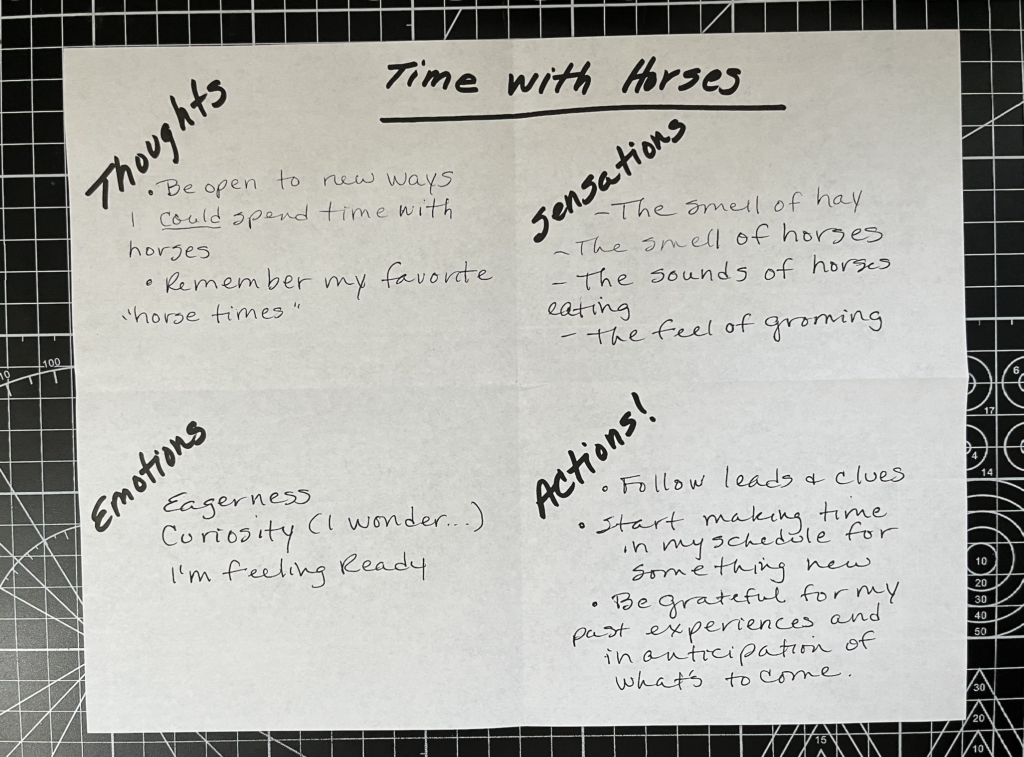
In this post, I’ll show you why that happens. Then I’ll walk you through a simple exercise, on video and in writing. All you need is one piece of paper. It’s the same exercise I shared with a small group of past mastermind clients for a month-long experiment. And I’ll tell you what happened when they lived with it.
“When you change the way you look at things,
the things you look at change.”
— Wyne Dyer
Weather and Landscape
Your “state” is the weather. It changes by the hour. Sun, then clouds, then a sudden downpour, then sun again.
In an earlier post, Something Has to Flip First, I wrote about switches. These are the small things that shift your weather on purpose: a smell, a song, a slow breath, gentle rocking. That’s real, and it works.
Your “being” is the landscape. The mountains. The rivers. The soil. What grows there, and what doesn’t. The landscape doesn’t change by the hour. But it decides a lot about what weather shows up.
Here in Oregon, we have a living example. The Cascade mountains run north to south through the middle of the state. Clouds roll in off the Pacific, hit the mountains, and drop their rain on the west side. That’s why the west side is green and mossy and wet. By the time the air makes it over the peaks, most of the rain is gone. The east side is high desert.
Same storms. Same sky. Completely different weather, because of the landscape underneath.
What Makes Up Your Landscape?
Most of us think of who we are as the way we think. That’s one hill in a very big landscape.
Your being includes your thoughts, your beliefs, and the stories you tell yourself. Your emotions, fears, and hopes. Your body: your nervous system, your sensations. Your habits and patterns. And the ways you relate to the people and the world around you.
And each of those is bigger than most of us were taught.
- One well-known model names eight kinds: words, numbers and logic, pictures and space, body and movement, music, people, self-knowledge, and nature. You have all of them, in your own mix.
- Dr. Paul Ekman identified seven universal emotions, recognized across all human cultures. Researchers at UC Berkeley later found at least 27. Brené Brown mapped 87 emotions and experiences we commonly name. Yet most of us were raised as if there were only five: mad, sad, glad, scared, and numb.
- We were taught we have five. Scientists now count many more: balance, temperature, pain, the sense of where your body is in space, the inner sense of your own heartbeat, breath, and hunger. And then there’s intuition, often called the sixth sense.
Now add every experience you’ve ever had. Your past. Your hopes for the future. Your birth order, your genetics, the conditions you grew up in. Your education, relationships, skills, preferences, and memories.
That’s your landscape. And no one else has yours. Not your siblings. Not your partner. Not the person who has the life you think you want. That’s why a one-size-fits-all plan so rarely fits.
How Weather and Landscape Shape Each Other
“Being” and “state” aren’t the same thing. But they aren’t separate, either. They shape each other, in both directions.
The landscape shapes the weather. If somewhere deep in your landscape lives the belief “I’m just not good with money,” your weather will cloud over every time a bill comes in. No switch will hold that off for long.
Here’s something that delights me. Researchers have found that when people are tired, or carrying a heavy backpack, a hill actually looks steeper to them. Your being doesn’t only shape your weather. It shapes how the landscape itself looks to you.
And the weather, over time, shapes the landscape. One rainstorm doesn’t carve a canyon. Years of water running down the same path does.
“Habit, if not resisted, soon becomes necessity.”
— Saint Augustine, Confessions
What we repeat becomes part of the ground we stand on. The good news is that it works both ways. What you repeat on purpose becomes part of the landscape, too.
So back to that Wednesday. You had a beautiful sunny day at the workshop. Then the landscape did what it always does, and the old weather rolled back in. State change gets you moving. Being change is what makes the movement last.
Jordan
A client of mine, Jordan, came to me after their partner gave them an ultimatum: slow down, or else. Jordan was working six days a week. They didn’t know how to work less. Worse, they were afraid that if they did, they’d lose themselves.
More rest wasn’t going to fix it. A weekend off is lovely weather, but Jordan’s landscape would have pulled them right back to the desk. Underneath the long hours was a belief about work and worthiness. As long as that belief was part of the ground, every free afternoon felt like danger.
So we didn’t start with a schedule. We started with small experiments. Try one thing. Notice what happens. Keep what works. Bit by bit, we got curious about that old belief and began to challenge it.
The landscape shifted. Jordan cut their hours by a third. Their income doubled, even after bringing on two part-time team members. And they now have a three-day weekend with their partner, every week. The answers came from inside Jordan’s own landscape, once it had room to change.
Four Streams
So how do you change a landscape, on purpose? Not with one big storm. With small streams, running the same direction, again and again.
Here’s what most of us miss. There isn’t just one stream. There are at least four: your thoughts, the sensations in your body, your emotions, and your actions.
Most change plans work only one stream. Think positive. Or just take action. Or feel your feelings. One stream helps. But when all four run toward the same place, they start to cut a new channel. That’s when the landscape begins to change.
That’s what this next exercise is for. It helps you line up all four.
Fold the Paper
You’ll need one sheet of paper and a pen. That’s it.
Before you start, pick one thing you want. A goal. A feeling you want more of. A way of being you want to live. Something you’ve been circling for a while.
Watch: Let’s Fold It Together
In this video, I’ll walk you through the whole exercise, step by step. It’s the same process I took the experiment participants through. Grab your paper and press play.
Prefer to Read? Here Are the Steps
There’s no wrong way to do this. Go in any order. Skip around. Come back later. Your paper, your way.
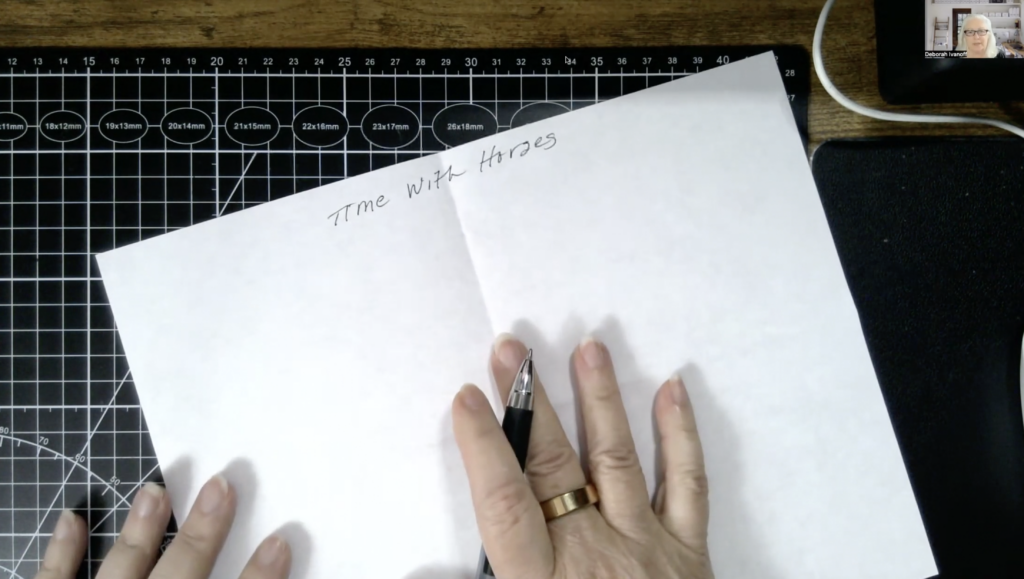
- Fold it and name it.
Fold your paper in half, then in half again. Open it up. You’ll have four squares. At the top, write the one thing you picked. This is where you want your streams to run.
- Label your squares.
Write one word in each square: Thoughts, Sensations, Emotions, Actions. Put them wherever feels right to you. There’s no correct square.
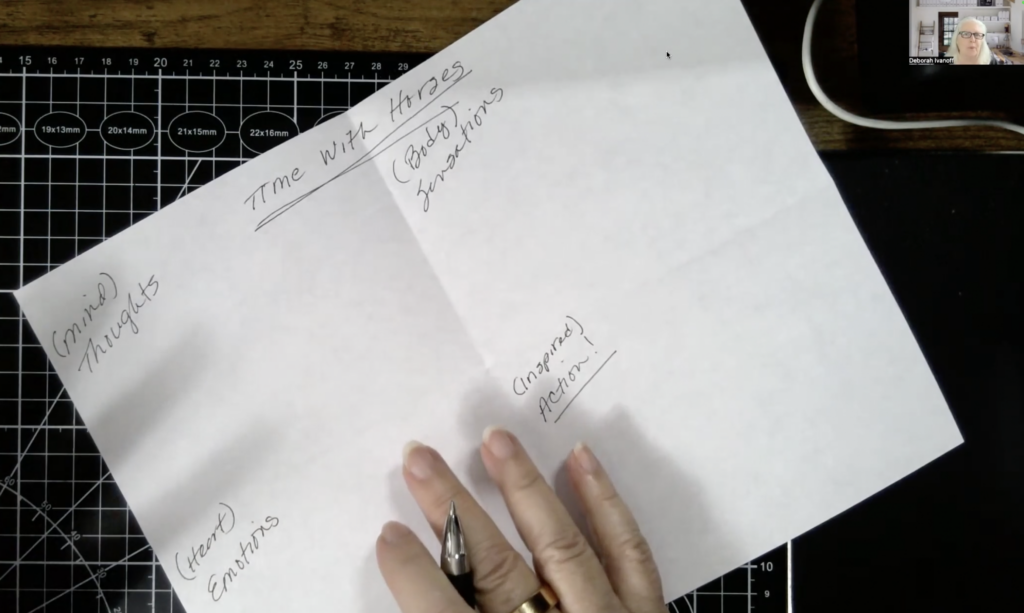
3. Fill in your squares.
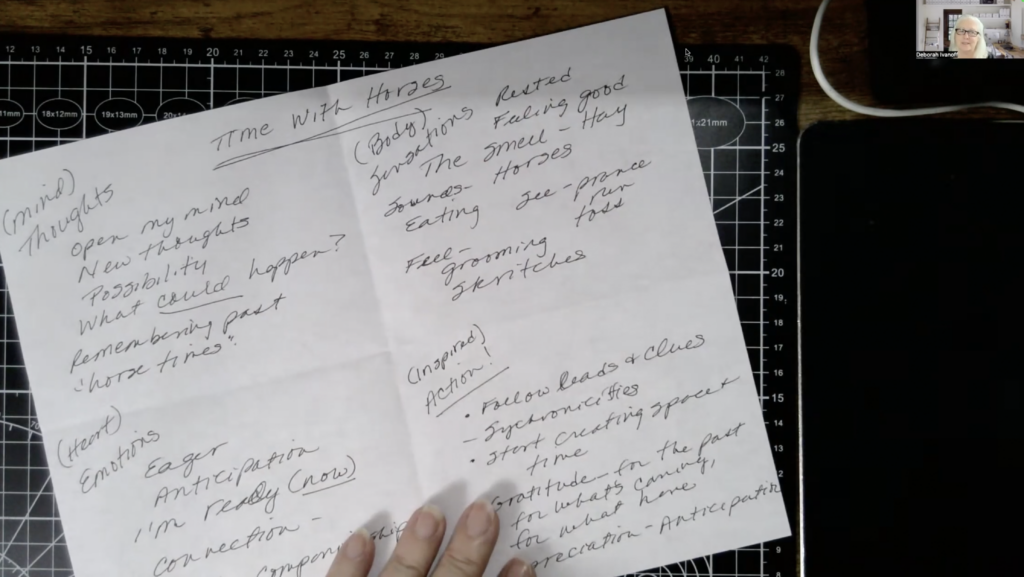
Ask yourself these four questions, in whatever order comes to you. Write each answer in its square.
- Thoughts: What thoughts can I practice that help me be or have this?
- Sensations: What physical sensations help me step into this?
- Emotions: What emotions support this?
- Actions: What actions bring me closer to this, or invite more of it?
There are no wrong answers. If what you wrote helps you and feels good, let it guide you.
- Keep it close.
Put your paper where you’ll see it. Your desk. Your nightstand. Your journal. And keep adding to it. Over the weeks, you’ll notice what supports this new way of being. A thought. A song. A place. A person. A walk. Write it down. Your paper grows as you do.
What Happened When We Tried It for a Month
Here’s where the exercise came from. I wanted to see what would happen if people used their own switches on purpose, every day, for a whole month. Not once. Not only when they remembered. Regularly, with focus.
So I invited some past mastermind grads to play along. These are people who already have tools and know how to use them. We called it the “Be It to See It” Experiment. Choose the way of being you want. Find the switches that help you step into it. Practice for a month. Check in weekly.
I’ll be honest. Not everyone practiced every day. Life happened. And the folks who practiced least saw the least change. Which is exactly the point. The landscape changes where the water runs. The good news? Once they saw that, they could choose again.
Here’s some of what showed up for those who kept their streams running:
- Movement was a big switch. Swimming, biking, running, dancing. People simply felt better afterward, and the world looked brighter.
- Several caught themselves holding their breath, and let it go. Anxiety eased.
- They heard their inner critic sooner, and moved past it before it slowed them down.
- They looked at their strengths and weaknesses kindly. They caught the “shoulds,” and dropped some. They let go of needing to fix anyone, themselves included.
- One person described coming back to their own autonomy, no longer looking to others for approval.
- Other people noticed the shift, and said so. Customers made the first move.
- The experiment was never meant to be a sales tool. But new clients and deals showed up anyway. One past client closed her first deal of the year, breaking a long dry spell. Coincidence? I think not. 🙂
- New resources appeared. A book. A program. A teacher. Even a song.
- Many began asking, “What else could I change?” Some rethought bigger choices: where they live, who they spend time with, their work. And some reorganized their spaces, from the car’s front seat to the garage.
- Days had more flow. Life felt lighter, and sometimes more fun!
When you change the way you look at things, the things you look at change. That’s what Dyer meant.
And Me?
I wasn’t only the facilitator. I was a participant, too.
During our month, I felt so much more flow and synchronicity. My schedule kept rearranging itself to better suit my energy, or to make room for a client’s urgent need. I got so used to it that when something shifted, I’d just chuckle. Some power knew better than I did who needed what, and when.
Then the gifts started showing up. My daughter asked me out on a Mother-Daughter date, “just because.” Priceless. I found a nonprofit right here in Portland that rescues Arabians, my favorite breed, and needs volunteers. Hello, much-needed horse time love! And I was introduced to a woman who worked until she was 101. (I kid you not.) She’s become an inspiration and a touchstone for me as I keep shaping the quality of my life, chapter by chapter.
And the Other Shoe
Here’s one I didn’t expect. More than one person noticed that when things felt better, a small fear crept in. When is the other shoe going to drop?
That makes perfect sense. That’s the old landscape talking. It’s used to a certain kind of weather. When the sun stays out longer than usual, part of you starts watching the sky.
It doesn’t mean something bad is coming. It means something is changing. You can notice the fear, thank it, and keep the water running.
Your Turn
Fold your paper. Name the one thing. Fill your four squares. Then keep it close for a month, and watch what changes.
If you’ve been there, lit up on Sunday and back in the same old place by Wednesday, nothing is wrong with you. You were working on the weather. Lasting change lives in the landscape, and it’s very hard to see your own landscape while you’re standing in it.
That’s the part I help with. If you try this and want to talk about what you noticed, or you’re bracing for that other shoe, reach out. I’d love to hear about it.
As Dolly Parton put it: “Find out who you are and do it on purpose. And do it with purpose.”
What the Experimenters Reached For
Some of the tools, practices, and resources participants used during the experiment. Maybe one will call to you.
- The Lighthouse Visualization — Darel Rutherford
- The Power Pause Visualization — John Harricharan
- Affirmation: “If it is to be, it’s up to me.” — William H. Johnsen (1901–1970)
- Affirmation: “Everything is always working out for me.” — Abraham (channeled by Esther Hicks)
- AID Meditation (Appreciation, Intention, Delegation) — Thach Nguyen
- AIP (Appreciation, Intention, Prayer) — a participant’s own version
- The Sedona Method
- Human Design
- Open Focus — Dr. Les Fehmi
- The Artist’s Way — Julia Cameron
- Pilates
- Mastermind meetings
Photos/videos from my desk 🙂