
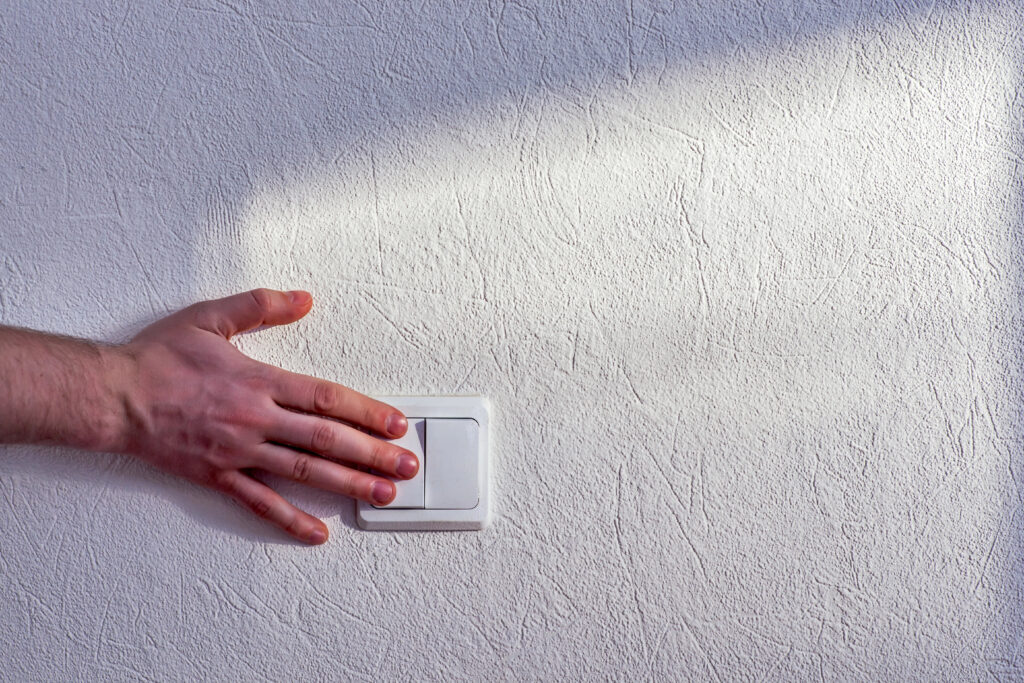
There’s something between you and what you want. It’s not a missing plan. It’s not “not knowing what to do next”. It’s a switch that hasn’t been flipped yet. And until it flips, nothing else moves — no matter how good the plan is.
“To change your life, you have to change your state of being.
Your state of being is how you think and how you feel.
If you keep doing the same things,
thinking the same thoughts,
and feeling the same emotions every day,
your life will stay the same
because your state of being
remains the same.”
— Dr. Joe Dispenza, Breaking the Habit of Being Yourself
Here’s what I mean by a “state.” It’s not just your mood. It’s everything underneath your mood — your posture, your breathing, your nervous system, your habits, your beliefs, even old patterns you picked up so long ago you don’t remember picking them up. A state change is any shift in that whole system. Not just feeling different. Being different, for a moment, in a way your body can feel.
Here’s the part that’s surprised me most, over years of doing this work: you don’t have to change the thing you think you need to change. Any real state change makes you more flexible. And flexibility is what leads to the next change, and the one after that. Skip a few steps right now and you’ll feel a small burst of joy — that’s not a mindset thing, it’s your nervous system, and it works that way for everyone. Rock gently, side to side or front to back, and most people feel calmer within seconds. Guaranteed, every time, because of how we’re wired.
This idea has a real history, if you’re curious. In the 1970s, Richard Bandler and John Grinder built a whole field — Neuro-Linguistic Programming — partly around it: your state, the mix of body, thoughts, and feelings you’re in right now, can be changed on purpose. They didn’t invent that from nothing. They studied three master therapists — Fritz Perls, Virginia Satir, and Milton Erickson — and noticed all three were doing this instinctively, without ever naming it. Tony Robbins trained under Grinder in the 1980s and took “state change” further than anyone, into stadiums full of people. But the roots go back to three therapists paying very close attention to what actually worked.
A client of mine, Ken, came to me stuck. Not lost — he knew exactly where he wanted to go. He just couldn’t get himself moving. He had so much he wanted to do, all at once, that he couldn’t do any of it. It was like standing in a dark room with your arms out, unable to find the switch.
So I asked him a strange question: what’s one thing — not on your list, nothing you need to do — that you could do easily, with no resistance at all? He thought about it and said: sell the piano. He hadn’t touched it in years. He knew he wasn’t taking it with him. It wasn’t part of any plan.
He sold the piano. And something shifted. Not because selling a piano solves anything — it doesn’t. But that one small, easy action flipped something in him. Within weeks he was moving in his own direction, on his own steam, toward things that had felt impossible a month before. I didn’t assign him that step. He found it himself, once he was flexible enough to look.
Here’s something else I’ve noticed: once someone’s state shifts, it can look like the whole world responds differently. It’s not the world. It’s the filter.
Your brain filters almost everything you experience — it has to, or you’d be overwhelmed by every sound and color and detail, all day long. That filtering is useful. It’s also why, if nothing changes on the inside, you tend to keep getting what you’ve always gotten. You’re not seeing all of it. You’re seeing what your filter lets through.
I do an exercise in my trainings: I hand out colored glasses — red, blue, green — while everyone’s eyes are closed. Then I pass around plain yellow paper and ask what color it is. I get “orange.” I get “green.” I get “lime green.” Same paper. Different filters. Nobody’s wrong. They’re each just looking through their own glasses.
So, How Do You Change It?
Your body has switches. Real ones. Physical ones. You’ve probably been flipping them your whole life without ever calling them that.
Smell might be the fastest one you own — walk into a kitchen where something’s baking and notice what happens to your face before you’ve decided anything. Taste does something similar: a favorite summer food can bring comfort, celebration, home, all at once. Touch works too — petting an animal you trust actually slows your heart rate, which is the whole idea behind pet therapy. Sound is one you already know; you have a private playlist for getting moving and a different one for settling down, even if you’ve never written either down. And sight — what you look at can change your state, too. A mentor of mine kept a photograph of a still lake behind his desk, and turned to look at it whenever he felt himself sinking into a heavy state.
There’s also a quieter set of switches — the ones inside you. Your breath. Your heartbeat. Your posture and balance. Slowing your breath on purpose changes your physiology, which changes your state, every time — not because you believe in it, but because of how the nervous system works. And there’s a sixth one worth naming: intuition. That fast, wordless “something’s off” or “this is right” feeling isn’t magic either — it’s your brain processing everything your five senses picked up, faster than you can consciously follow.
You don’t need to remember all of that. Out of everything above, find the one that works fastest for you — your one reliable switch. Then find two or three backups, for the times your first one isn’t available. That’s the whole toolkit. Not a long list to memorize. A short one you actually reach for.
Here’s what tends to happen next, in order: your state shifts. Then you act differently, because a different state makes different actions easier. Then other people respond to you differently, because you’re not bringing the same energy into the room. This works in both directions, which is exactly why it matters which switch you’re reaching for — the same pattern that moves you toward what you want can move you away from it, just as easily.
Years ago, I worked with a client named Monica, a single mom with four kids, who was afraid of the dark. In summer, that’s a hard thing to carry — her kids wanted to run in the backyard at night, chasing fireflies, and she couldn’t join them.
We didn’t fix it all at once. We started with rocking. She moved her rocking chair a little closer to the French doors each evening, watching her kids laughing in the yard. When she reached the edge of the light, she opened the doors a little more. Night by night, the doors opened further. Eventually she moved her chair just outside them, still rocking. Not long after that, she was in the grass with her kids, looking up at the stars, fear gone — and that one shift rippled outward into new work, new travel, things she couldn’t have imagined a summer earlier.
Notice how many switches she was using without ever naming them: sound, sight, touch and movement, and the slow, repeated proof that she was safe. She didn’t need a five-year plan. She needed one switch, used consistently, moving her an inch at a time.
Your Turn
This week, be a detective in your own life. Notice what shifts you toward a state that helps you — more energy, more patience, more creativity, more confidence. Notice what shifts you toward one that doesn’t. Neither is wrong; every state carries information. But not every state moves you where you want to go.
Then pick one switch — one sense, one small physical shift — and try reaching for it on purpose this week. Notice what happens.
If you try it and want to talk about what you noticed — or you’re having trouble seeing your own switch at all — reach out. Reach me at info@deborahivanoff.com or schedule an open conversation. I’d love to hear about it.
Photo from Depositphoto.com